Showing posts with label Nutrition. Show all posts

09 January 2013

Teaching - Cours de Cuisine à Genève - Printemps 2013

Cours de cuisine végétalienne basées sur l'équilibre, la variété, la couleur, les saveurs, en respectant le rythme des saisons, le dynamisme des styles de cuissons, l'utilisation de céréales complètes, de légumes et fruits, de légumineuses, algues et protéines végétales biologiques.

Si la préparation du tofu, du tempeh, du seitan ou encore des légumineuses, mais aussi des algues, des céréales et des légumes de saison vous intéresse, voici les dates de prochains cours de ce printemps :

Février :
• Mercredi 6 / Mercredi 20 / Mercredi 27

Mars :
• Mercredi 6 / Mercredi 13 / Mercredi 20

Ces cours ne sont pas des ateliers.
La densité des informations, le temps imparti et l’espace à disposition ne permettent pas de faire travailler les participants.

La cuisine de Sosoa
De :19h00 à 22h00 en petit comité de 10 personnes
Lieu : Les Acacias à Genève, chemin de la Gravière N°2
Prix : Frs. 50.- dégustation et support de cours compris


_Posted by X0X83X_  

30 September 2012

Promotion - Pledge Vegan website

PledgeVegan.com is a website dedicated to helping people commit to and continue living a vegan lifestyle. 

Super interesting website with lot different actions, resources, articles, nutrition tips and recipes, Just have a look clicking the banner below and spread the word !

http://www.pledgevegan.com/

_Posted by X0X83X_  

02 September 2012

Teaching - Cours de Cuisine à Genève - automne-hiver 2012

Cours de cuisine végétalienne basées sur l'équilibre, la variété, la couleur, les saveurs, en respectant le rythme des saisons, le dynamisme des styles de cuissons, l'utilisation de céréales complètes, de légumes et fruits, de légumineuses, algues et protéines végétales biologiques.

Si la préparation du tofu, du tempeh, du seitan ou encore des légumineuses, mais aussi des algues, des céréales et des légumes de saison vous intéresse, voici les dates de prochains cours de cet automne-hiver :

Octobre :
• Mercredi 3 / Mercredi 10 / Mercredi 17 / Mercredi 31

Novembre :
• Mercredi 7 / Mercredi 21 / Mercredi 28

Décembre :
• Mercredi 5

La cuisine de Sosoa
De 19h à 22h en petit comité de 10 personnes
Lieu: à Genève, chemin de la Gravière N°2
Prix: Frs. 50.- dégustation et support de cours compris
Réservation: lacuisinedesosoa(at)gmail.com
Plus d'informations: www.lacuisinedesosoa.blogspot.com 


_Posted by X0X83X_  

13 July 2012

Nutrition - Les Algues

Les algues sont les végétaux les plus anciens, et sont à l'origine de la vie sur la Terre puisqu'ils ont été les premiers êtres vivants à créer l'oxygène. 
Elles furent ainsi le point de départ de toute l'histoire des plantes et celui de règne animal et humain.
Leur véritable intérêt pour nous consiste en ce qu'elles apportent un complément important en sels minéraux, oligo-éléments et renforcent le système endocrinien, c'est à dire les glandes comme la thyroïde, ou le pancréas, grâce à leur apport en iode. 

Des études récentes montrent comment les algues peuvent compenser les insuffisances nutritionnelles dans le monde.

Elles poussent dans un milieu très simple et éloigné du nôtre, et leurs caractéristiques sont très simples aussi:
  • 1 seule variété de cellules.
  • Pas de vaisseau conducteur de sève.
  • Pas d'appareil d'absorption, l'échange nutritif se fait par osmose + O2.
  • Pas de racines, juste un crampon pour s’accrocher.
Cette simplicité est très bonne pour nous, qui vivons dans un monde compliqué, sophistiqué et chaotique.

Elles ont en général un effet fortifiant et reminéralisant

On peut les consommer:
  • Fraîches, immédiatement.
  • Conservées au sel; doivent être rincées abondamment avant l’utilisation d'où risque de légère perte en éléments nutritifs.
  • Séchées à l'air libre: se conserve des années, plus médicinal
  • Cuites: plus médicinal également.
Les algues permettent :
  • De nous nourrir en vitamines, minéraux et oligo-éléments
  • De rééquilibrer le sang.
  • D’éliminer des déchets et purines, en particulier en provenance des produits d'origine animale et dérivés laitiers.
  • D'éliminer les déchets radioactifs.
  • De nous nettoyer autant le corps que l'esprit, en profondeur
  • De nous simplifier la vie.
  • Littéralement de nous purifier.
Elles sont particulièrement indiquées à notre époque où nous souffrons à la fois d'excès de calories et de carences importantes en éléments vitaux, minéraux et vitamines.

Plus d'informations sur le Grain de Vie : www.graindevie.org

_Posted by X0X83X_

20 June 2012

Nutrition - Le Silicium Organique G5

Le Silicium est un oligo-élément clé de notre métabolisme

Notre organisme contient environ 7 grammes de Silicium, localisé principalement au niveau des os, de la paroi des vaisseaux et du tissu conjonctif. Les végétaux absorbent de très grandes quantités de silicium et elles ont la capacité de le solubiliser et de le rendre biodisponible.
Chez l’homme une carence en silicium est très fréquente et accélère le processus de vieillissement.

Le silicium et la croissance osseuse
On sait depuis longtemps que les animaux nourris avec un régime pauvre en silicium ont une croissance osseuse très ralentie et très perturbée ; des poulets élevés ainsi sont rachitiques avec des plumes chétives et mal formées. Par ailleurs les articulations contiennent moins de cartilage. Le silicium est un constituant essentiel des os et des dents. Un apport complémentaire de silicium s’impose pour lutter contre l’ostéoporose et la déminéralisation.

Le silicium et les artères
Le silicium joue un rôle de ciment dans la paroi des artères en se liant aux grosses molécules de mucopolysaccharides et au collagène. Ainsi il solidifie la paroi artérielle et renforce son élasticité. Il permet ainsi d’éviter la fragilisation et la lésion des artères caractéristiques des troubles cardiovasculaires.
Des études épidémiologiques ont montré que le taux d’athérosclérose est inversement proportionnel au taux de silicium dans l’eau de boisson.

Le silicium et la jeunesse de la peau
Les sources thermales réputées pour leurs effets bénéfiques sur la peau sont très riches en silicium, jusqu’à 100mg par litre. Le silicium assure en effet la souplesse et l’élasticité de la peau car il est lié aux grosses molécules du tissu conjonctif, permettant ainsi une meilleure hydratation.
On comprend ainsi mieux pourquoi les « boues thermales », très riches en silicium, à la fois soulagent les articulations et donnent la peau douce.

Le silicium, antidote naturel de l’aluminium
De nombreux chercheurs commencent à s’inquiéter du rôle néfaste de l’aluminium sur la santé et on sait maintenant que la concentration cellulaire d’aluminium augmente avec l’âge, en particulier au niveau des os, des articulations et des cellules nerveuses. Ainsi l’aluminium est impliqué dans le développement de l’ostéoporose, de l’arthrose et du vieillissement cérébral, en particulier dans la maladie d’Alzheimer.
Or le silicium a une forte affinité pour l’aluminium pour former un silicate d’aluminium insoluble ; l’aluminium est ainsi « bloqué » et ne peut plus interférer avec le métabolisme.

Un apport complémentaire en silicium
Les céréales complètes sont riches en silicium de même que la prêle. Mais comme notre alimentation est pauvre en oligo-éléments nous sommes généralement carencés en silicium. Une équipe de chercheurs de Toulouse a d’ailleurs montré que l’incidence de perturbations cognitives et de la maladie d’Alzheimer est plus importante parmi les populations qui boivent une eau pauvre en silicium.
Pour freiner le vieillissement, il est donc très utile de se complémenter avec du silicium organique bioassimilable, comme celui qui est présent dans les plantes.

Il existe aussi du silicium sous forme de gel pour usage externe pour applications locales, très efficace.


Produit en vente à Genève au Grain de Vie. 
Silicium G5 Siliplant 1000ml pour CHF 43.- (sous forme liquide)
Plus d'informations: www.graindevie.org

_Posted by X0X83X_

14 June 2012

Verschiedenes

Link zur Studie "Red meat consumption and mortality" (in englisch): Klick.

Verschiedene Fragen & Antworten zur veganen Ernährung (aus medizinischer Sicht), zum Beispiel ob Soja ungesund ist (in englisch): Klick.

"The Most Harmful Foods For The Environment" (9/10 tierischer Herkunft): Klick.
Dazu eine interessante Randnotiz: "Der Ursprung der Produkte und ihre Herstellung ist für 83% ihrer Emissionen verantwortlich, der Transport aber nur für 11%." (veganblog.de) Es scheint also wichtiger zu sein, darauf zu achten, dass die Produkte bio sind, als woher sie stammen. Also eher bio aus Italien, als nicht bio aus der Schweiz. Weitere Ergebnisse zu Nachforschungen in diese Richtung habe ich aber noch nicht gefunden. Bin zur Zeit aber damit beschäftigt. Informationen und Links können gerne per Email geschickt werden!

Wer hätte noch vor wenigen Jahren gedacht, dass sogar Krankenversicherer sich einmal für die vegane Ernährung aussprechen würden? (Link) Dann ist nun also doch mal die Forderung nach einer Prämienverbilligung für VeganerInnen gerechtfertigt!

_Posted by XSOJX_

05 June 2012

Vegan - Berichte auf rtl.de

"Zu viele Milchfette verlangsamen die Hirnaktivität": Link.
(An Tieren getestet, also mit Vorsicht zu geniessen. Trotzdem interessant, dass das Thema immer öfter auch in den Mainstream-Medien diskutiert wird).

"Es spricht sehr viel für fleischlose Ernährung": Link.

_Posted by XSOJX_

22 May 2012

Promotion - Blog to follow

Here is the link to the blog of Neal Barnard, an american nutrition researcher. Click here. Make sure to check back on a regular basis. Very informative!

There is also VERY interesting videos of some of his speeches that I think everybody should at least overfly. You won`t regret!


_Posted by XSOJX_

14 March 2012

Nutrition - Aloe Vera

L'aloès ou en latin Aloe vera ou Aloe barbadensis ou Aloe vulgaris apartient à la famille des Liliacées (comme l'ail, la ciboulette, l'oignon, l'asperge, la tulipe, le lys). On l'appelle donc communément l'Aloès ou également Lys du désert.

L'aloe vera est une plante arborescente de 60 à 80 cm de hauteur, aux racines peu profondes, dont la tige très courte et ligneuse porte un faisceau de feuilles charnues lisses de couleur verte, à section triangulaire, aux extrémités pointues, dont les plus grandes peuvent atteindre 80 cm de hauteur et 10 cm dans leur plus grande largeur avec des bords munis d'épines jaune clair.
Sa reproduction s'opère par graines ou plus aisément par les rejets (stolons) qui poussent autour de son pied. Facile à cultiver, il est aujourd'hui planté sur de vastes étendues dans de nombreux pays : Espagne, Etats-Unis, Mexique, Caraïbes, Philippines, …

Il est désormais établi que l'Aloe vera possède de nombreuses propriétés fort utiles à la santé.
Ne figure ici que celles qui sont parfaitement confirmées à ce jour.

Vertus nutritionnelles : dans le cadre de la complémentation alimentaire, la pulpe de l'Aloe vera apporte un appoint en éléments vitaux (acides aminés, minéraux et oligo-éléments, vitamines, etc) quantitativement peu important mais qualitativement d'une très grande richesse. Cette richesse qualitative débouche sur une bonne rééquilibration organique et augmente la résistance du terrain biologique, lui permettant ainsi de mieux résister aux agressions de toutes sortes (microbiennes, stress, etc.) dont il est en permanence l'objet.

Vertus digestives : notamment une bien meilleure digestion des aliments (grâce aux nombreuses enzymes qu'elle contient) avec diminution des putréfactions intestinales ainsi qu'une légère action apéritive et une action tonifiante sur les intestins susceptible de régulariser un transit intestinal ralenti, mais sans action laxative proprement dite.

Vertus dermatologiques, du fait de ses actions : hémostatique, anesthésique, bactéricide, cicatrisante et anti-inflammatoire (liées à nombre de ses composants, agissant vraisemblablement en parfaite synergie) qui sont toutes fondamentales pour obtenir rapidement la guérison d'une grande part de la pathologie cutanée traumatique (blessures, brûlures, irritations, etc.) ou non traumatique (les dermatoses en général).

D'autres propriétés très importantes (anti-ulcéreuse gastrique, anti-diabètique, etc.) sont en cours d'études et en voie d'être reconnues. Cosmétologiques du fait de ses extraordinaires actions cutanées : rééquilibration du pH cutané, desquamation des cellules mortes de l'épiderme, hydratation et nourrissement de la peau en profondeur, stimulation de la multiplication cellulaire des fibroblastes du derme, qui font de la pulpe de l'Aloe vera un véritable "régénérant" cutané. Actions auxquelles s'ajoutent encore ses propriétés : astringentes, adoucissantes et protectrices, qui en font l'un des plus remarquables produits naturels de beauté que l'on puisse trouver.
_Posted by X0X83X_

14 January 2012

Weekly video


Hahahaha ... for all you unhealthy vegans!

_Posted by XSOJX_

26 November 2011

Nutrition - La viande

Article intéressant du point de vue de la macrobiotique sur la viande.

La viande coûte cher. Elle n’est ni économique, ni écologique (la production d'1kg de protéines animales demande 7x plus de terrain que la production d'1kg de protéines végétales).
La moitié de l’eau potable utilisée par l’être humain sert aux élevages d’animaux. La production de viande emploie 20 à 150 fois plus d’eau que la production de céréales.

Les animaux d'élevage sont parqués et traités. Les abattoirs génèrent angoisse et décharges d'adrénaline.

La viande est exempte de fibres d'où surgissent des problèmes intestinaux.
La viande est riche en graisses saturées, en toxines et purines, demandant trois jours pour être éliminées. La viande provoque donc une pollution et un empoisonnement du corps dès qu'elle est prise plus de deux fois par semaine. Ceci augmente les risques de développer des maladies de dégénérescence, cardio-vasculaires et autre, la goutte étant l'une de leurs premières manifestations.

La viande rend le sang acide et, tout en étant trop yang, elle nous pousse ensuite vers l'extrême yin, lui aussi acidifiant; deuxième risque de développement de maladies de dégénérescence, à commencer par une moins bonne tolérance au stress, l'équilibre devenant plus difficile à trouver et à maintenir.

La viande diminue et affaibli la condition et l'immunité naturelle. Si certaines personnes ressentent un regain de vigueur après avoir consommé de la viande, cela est en fait dû à la caféine qu’elle contient, laquelle épuise à la longue les reins et la force vitale. C’est donc une vitalité très passagère avec manque d'endurance tant physique que psychique.

Les recherches en immunologie ont démontré que la protéine bovine est la substance la plus allergène connue pour l'homme !
En d'autres termes, ces protéines sont les facteurs antigènes les plus agressifs pour notre système immunitaire", Martha Cottrell, Docteur en médecine, chargée d'une étude médicale aux USA en 1997 sur l'application de la macrobiotique à un groupe de personnes atteintes du Sida.

La viande donne plus de difficultés à gérer ses émotions qui deviennent plus facilement chaotiques. Elle donne beaucoup d'agressivité, de sentiment de supériorité, d'arrogance et d'intolérance.

La viande diminue la souplesse corporelle et mentale, elle est biologiquement trop proche de nous, donc moins stimulant pour notre évolution (comme un mariage consanguin).

La viande a tendance à donner une spiritualité plus étouffée à cause de l'orientation horizontale du système nerveux des animaux, celui des êtres humains étant vertical, il est plus fort et mieux relié aux sources terrestre et cosmiques.

 Aperçu théorique sur la nutrition macrobiotique dispensé par "Le Grain de Vie"
Plus d'informations: www.graindevie.org
 
_Posted by X0X83X_

19 October 2011

Dokumentarfilm - Du bist, was du isst

Diesen Film habe ich ohne grosse Erwartungen letzte Woche gekauft. Habe ihn eben gesehen und kann ihn nur weiterempfehlen. Vielleicht für einige nicht gerade mit vielen Neuigkeiten, dennoch sind sicherlich für alle einige interessante Infos enthalten.


English trailer:


_Posted by XSOJX_

15 October 2011

Nutrition - What Every Vegan Should Know About Vitamin B12

Very low B12 intakes can cause anaemia and nervous system damage.

The only reliable vegan sources of B12 are foods fortified with B12 (including some plant milks, some soy products and some breakfast cereals) and B12 supplements. Vitamin B12, whether in supplements, fortified foods, or animal products, comes from micro-organisms.

Most vegans consume enough B12 to avoid anaemia and nervous system damage, but many do not get enough to minimise potential risk of heart disease or pregnancy complications.

To get the full benefit of a vegan diet, vegans should do one of the following:
  • eat fortified foods two or three times a day to get at least three micrograms (μg or mcg) of B12 a day or
  • take one B12 supplement daily providing at least 10 micrograms or
  • take a weekly B12 supplement providing at least 2000 micrograms.

If relying on fortified foods check the labels carefully to make sure you are getting enough B12. For example, if a fortified plant milk contains 1 microgram of B12 per serving then consuming three servings a day will provide adequate vitamin B12. Others may find the use of B12 supplements more convenient and economical.

The less frequently you obtain B12 the more B12 you need to take, as B12 is best absorbed in small amounts. The recommendations above take full account of this. There is no harm in exceeding the recommended amounts or combining more than one option.

Good information supports vegan health, pass it around.

If you don't read another word about B12 you already know all you need to know. If you want to know more, read on.

This information was prepared by Stephen Walsh, a UK Vegan Society trustee, and other members of the International Vegetarian Union science group (IVU-SCI), in October 2001. This information may be freely reproduced but only in its entirety.

Vitamin B12 and vegan diets - Lessons from history

B12 is an exceptional vitamin. It is required in smaller amounts than any other known vitamin. Ten micrograms of B12 spread over a day appears to supply as much as the body can use. In the absence of any apparent dietary supply, deficiency symptoms usually take five years or more to develop in adults, though some people experience problems within a year. A very small number of individuals with no obvious reliable source appear to avoid clinical deficiency symptoms for twenty years or more. B12 is the only vitamin that is not recognised as being reliably supplied from a varied wholefood, plant-based diet with plenty of fruit and vegetables, together with exposure to sun. Many herbivorous mammals, including cattle and sheep, absorb B12 produced by bacteria in their own digestive system. B12 is found to some extent in soil and plants. These observations have led some vegans to suggest that B12 was an issue requiring no special attention, or even an elaborate hoax. Others have proposed specific foods, including spirulina, nori, tempeh, and barley grass, as suitable non-animal sources of B12. Such claims have not stood the test of time.

In over 60 years of vegan experimentation only B12 fortified foods and B12 supplements have proven themselves as reliable sources of B12, capable of supporting optimal health. It is very important that all vegans ensure they have an adequate intake of B12, from fortified foods or supplements. This will benefit our health and help to attract others to veganism through our example.

Getting an adequate amount of B12

National recommendations for B12 intakes vary significantly from country to country. The US recommended intake is 2.4 micrograms a day for ordinary adults rising to 2.8 micrograms for nursing mothers. The German recommendation is 3 micrograms a day. Recommended intakes are usually based on 50% absorption, as this is typical for small amounts from foods. To meet the US and German recommendations you need to obtain sufficient B12 to absorb 1.5 micrograms per day on average. This amount should be sufficient to avoid even the initial signs of inadequate B12 intake, such as slightly elevated homocysteine and MMA levels, in most people. Even slightly elevated homocysteine is associated with increased risk of many health problems including heart disease in adults, preeclampsia during pregnancy and neural tube defects in babies.

Achieving an adequate B12 intake is easy and there are several methods to suit individual preferences. Absorption of B12 varies from about 50%, if about 1 microgram or less is consumed, to about 0.5% for doses of 1000 micrograms (1 milligram) or above. So the less frequently you consume B12, the higher the total amount needs to be to give the desired absorbed amount.

Frequent use of foods fortified with B12 so that about one microgram of B12 is consumed three times a day with a few hours in between will provide an adequate amount. Availability of fortified foods varies from country to country and amounts of B12 vary from brand to brand, so ensuring an adequate B12 supply from fortified foods requires some label reading and thought to work out an adequate pattern to suit individual tastes and local products.

Taking a B12 supplement containing ten micrograms or more daily provides a similar absorbed amount to consuming one microgram on three occasions through the day. This may be the most economical method as a single high potency tablet can be consumed bit by bit. 2000 micrograms of B12 consumed once a week would also provide an adequate intake. Any B12 supplement tablet should be chewed or allowed to dissolve in the mouth to enhance absorption. Tablets should be kept in an opaque container. As with any supplement it is prudent not to take more than is required for maximum benefit, so intakes above 5000 micrograms per week should be avoided despite lack of evidence for toxicity from higher amounts.

All three options above should meet the needs of the vast majority of people with normal B12 metabolism. Individuals with impaired B12 absorption may find that the third method, 2000 micrograms once a week, works best as it does not rely on normal intrinsic factor in the gut. There are other, very rare, metabolic defects that require completely different approaches to meeting B12 requirements. If you have any reason to suspect a serious health problem seek medical advice promptly.

Symptoms of B12 deficiency

Clinical deficiency can cause anaemia or nervous system damage. Most vegans consume enough B12 to avoid clinical deficiency. Two subgroups of vegans are at particular risk of B12 deficiency: long-term vegans who avoid common fortified foods (such as raw food vegans or macrobiotic vegans) and breastfed infants of vegan mothers whose own intake of B12 is low.

In adults typical deficiency symptoms include loss of energy, tingling, numbness, reduced sensitivity to pain or pressure, blurred vision, abnormal gait, sore tongue, poor memory, confusion, hallucinations and personality changes. Often these symptoms develop gradually over several months to a year before being recognised as being due to B12 deficiency and they are usually reversible on administration of B12. There is however no entirely consistent and reliable set of symptoms and there are cases of permanent damage in adults from B12 deficiency. If you suspect a problem then get a skilled diagnosis from a medical practitioner as each of these symptoms can also be caused by problems other than B12 deficiency.

Infants typically show more rapid onset of symptoms than adults. B12 deficiency may lead to loss of energy and appetite and failure to thrive. If not promptly corrected this can progress to coma or death. Again there is no entirely consistent pattern of symptoms. Infants are more vulnerable to permanent damage than adults. Some make a full recovery, but others show retarded development.

The risk to these groups alone is reason enough to call on all vegans to give a consistent message as to the importance of B12 and to set a positive example. Every case of B12 deficiency in a vegan infant or an ill informed adult is a tragedy and brings veganism into disrepute.

The homocysteine connection

This is not however the end of the story. Most vegans show adequate B12 levels to make clinical deficiency unlikely but nonetheless show restricted activity of B12 related enzymes, leading to elevated homocysteine levels. Strong evidence has been gathered over the past decade that even slightly elevated homocysteine levels increase risk of heart disease and stroke and pregnancy complications. Homocysteine levels are also affected by other nutrients, most notably folate. General recommendations for increased intakes of folate are aimed at reducing levels of homocysteine and avoiding these risks. Vegan intakes of folate are generally good, particularly if plenty of green vegetables are eaten. However, repeated observations of elevated homocysteine in vegans, and to a lesser extent in other vegetarians, show conclusively that B12 intake needs to be adequate as well to avoid unnecessary risk.

Testing B12 status

A blood B12 level measurement is a very unreliable test for vegans, particularly for vegans using any form of algae. Algae and some other plant foods contain B12-analogues (false B12) that can imitate true B12 in blood tests while actually interfering with B12 metabolism. Blood counts are also unreliable as high folate intakes suppress the anaemia symptoms of B12 deficiency that can be detected by blood counts. Blood homocysteine testing is more reliable, with levels less than 10 micromol/litre being desirable. The most specific test for B12 status is methylmalonic acid (MMA) testing. If this is in the normal range in blood (<370 nmol/L) or urine (less than 4 mcg /mg creatinine) then your body has enough B12. Many doctors still rely on blood B12 levels and blood counts. These are not adequate, especially in vegans. 

Is there a vegan alternative to B12-fortified foods and supplements? 

If for any reason you choose not to use fortified foods or supplements you should recognise that you are carrying out a dangerous experiment - one that many have tried before with consistently low levels of success. If you are an adult who is neither breast-feeding an infant, pregnant nor seeking to become pregnant, and wish to test a potential B12 source that has not already been shown to be inadequate, then this can be a reasonable course of action with appropriate precautions. For your own protection, you should arrange to have your B12 status checked annually. If homocysteine or MMA is even modestly elevated then you are endangering your health if you persist. 

If you are breast feeding an infant, pregnant or seeking to become pregnant or are an adult contemplating carrying out such an experiment on a child, then don't take the risk. It is simply unjustifiable. 

Claimed sources of B12 that have been shown through direct studies of vegans to be inadequate include human gut bacteria, spirulina, dried nori, barley grass and most other seaweeds. Several studies of raw food vegans have shown that raw food offers no special protection. 

Reports that B12 has been measured in a food are not enough to qualify that food as a reliable B12 source. It is difficult to distinguish true B12 from analogues that can disrupt B12 metabolism. Even if true B12 is present in a food, it may be rendered ineffective if analogues are present in comparable amounts to the true B12. There is only one reliable test for a B12 source - does it consistently prevent and correct deficiency? Anyone proposing a particular food as a B12 source should be challenged to present such evidence. 

A natural, healthy and compassionate diet 

To be truly healthful, a diet must be best not just for individuals in isolation but must allow all six billion people to thrive and achieve a sustainable coexistence with the many other species that form the "living earth". From this standpoint the natural adaptation for most (possibly all) humans in the modern world is a vegan diet. There is nothing natural about the abomination of modern factory farming and its attempt to reduce living, feeling beings to machines. In choosing to use fortified foods or B12 supplements, vegans are taking their B12 from the same source as every other animal on the planet - micro-organisms - without causing suffering to any sentient being or causing environmental damage. 

Vegans using adequate amounts of fortified foods or B12 supplements are much less likely to suffer from B12 deficiency than the typical meat eater. The Institute of Medicine, in setting the US recommended intakes for B12 makes this very clear. "Because 10 to 30 percent of older people may be unable to absorb naturally occurring vitamin B12, it is advisable for those older than 50 years to meet their RDA mainly by consuming foods fortified with vitamin B12 or a vitamin B12-containing supplement." Vegans should take this advice about 50 years younger, to the benefit of both themselves and the animals. B12 need never be a problem for well-informed vegans. 

Good information supports vegan health, pass it around. 

Further information: 
  • Dietary Reference Intakes for Thiamin, Riboflavin, Niacin, Vitamin B6, Folate, Vitamin B12, Pantothenic Acid, Biotin, and Choline, National Academy Press, 1998 ISBN 0-309-06554-2 
  • Vitamin B12: Are you getting it?, by Jack Norris 
  • Homocysteine in health and disease, ed. Ralph Carmel and Donald W. Jacobsen, Cambridge University Press, 2001, ISBN 0-521-65319-3 
Taken from the Vegan Society website.
For more informations, many useful articles and to buy products, visit www.vegansociety.com

If you want to order a proper B12 supplement, I'm using this B12 supplement for several years with good results :

Pure Advantage Vitamin B12 Methylcobalamin Spray :
  • 1oz (175 servings)
  • 500 mcg per spray of Vit. B12 methylcobalamin 
You can order it online directly from Pure Advantage (www.pure-advantage.net)

Vitamin B12 is one of the most important daily nutrients a person can get. Yet most people are not getting effective and adequate amounts of it. When people purchase the regular “off the shelf” B12 sublingual tablets, absorption rates are not equally effective.

Pure Advantage's B12 spray is a cut above other B12 products because it’s in the methylcobalamin form. Methylcobalamin is the most absorbable form of B12. This is extremely important when taking supplemental B12.

Unlike the inexpensive and common cyanocobalamin, Pure Advantages methylcobalamin is readily available for cellular absorption. Cyanocobalamin has to go through the first pass of the liver, where a small amount of methylcobalamin is produced. Then it enters the general (i.e. systemic) circulation. Another unique feature is the method of delivery. Sprays are known to be more effective in activating the saliva glands than capsules, pills, lozenges or drops. This allows the B12 to enter the bloodstream quickly and efficiently.

  • Helps regulate homocysteine levels
  • Plays a role in neurological activity
  • Increases energy levels
  • Improves sleep
  • Reduces stress
  • Enhances growth and repair of all cells
  • Aids in metabolism of carbohydrates and fats
  • Improves protein synthesis
  • Protects against nerve damage
  • Improves immune function
  • Increases mental alertness


_Posted by X0X83X_

13 October 2011

Vegane Gesellschaft Schweiz

Kommenden Monat wird die Vegane Gesellschaft Schweiz gegründet:

"Zum 1.11.11, dem Weltvegantag, wird sich die Vegane Gesellschaft der Öffentlichkeit präsentieren. Ausführliche Informationen über die Gesellschaft sowie Hintergrundinformationen zum Veganismus werden in den nächsten Wochen hier aufgeschaltet."

Weitere Informationen, Beitrittsformular etc., findest du auf vegan.ch.
Wir hoffen auf zahlreiche Mitglieder, damit dem Verein schnellstmöglich eine gewichtige Stimme verliehen wird.

_Posted by XSOJX_

08 October 2011

Nutrition - Vegane Nährstofftabelle

Unter folgendem Link findet sich eine sehr ausführliche Nährstofftabelle, die jede Menge Vitamine und deren Aufnahmemöglichkeiten erläutert:

Nährstofftabelle. (von: provegan.info)

Weitere interessante Downloads finden sich auf der Seite der SVV.

_Posted by XSOJX_ 

05 August 2011

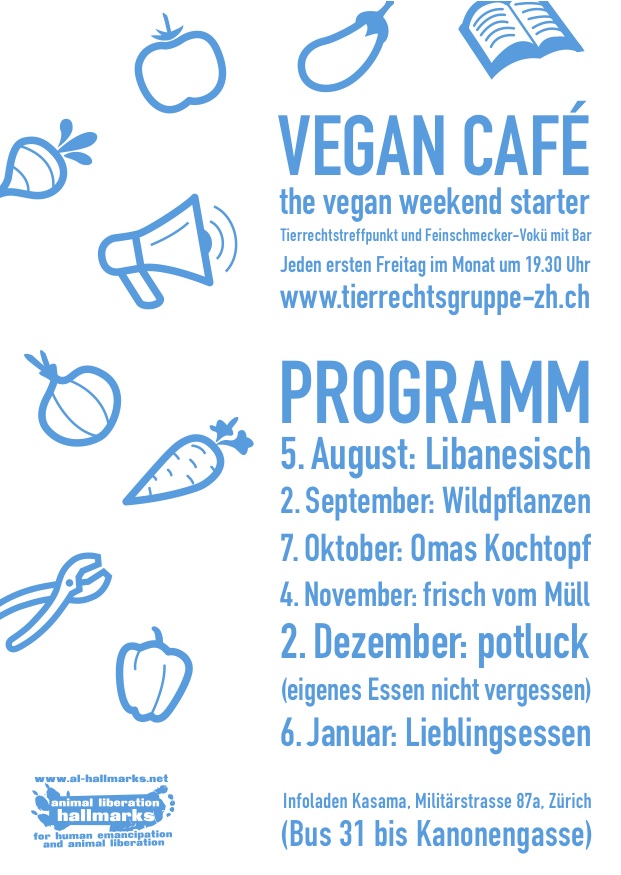
Vegan Cafe Zürich - Neue Daten

Hier die Daten der kommenden Veranstaltungen im Vegan Cafe:

_Posted by XSOJX_ 

30 July 2011

Nutrition - Vegan Catering Guides

The Vegan Catering for All and The Vegan Catering Guide for Hospitals and Care Homes are designed by The Vegan Society to be used by professional caterers and establishments to help them provide vegan food.

Vegan Catering for All is a general guide which is great for restaurants and cafes, and the Vegan Catering Guide for Hospitals and Care Homes is ideal for any establishment needing to produce nutritious food on a budget.

Contact The Vegan Society for free copies of Vegan Catering for All to give to restaurants and cafes in your area and encourage them to cater for vegans!

If you or a vegan friend or relative has a stay in hospital coming up or is in a care home, request the Vegan Catering Guide for Hospitals and Care Homes to pass on to the catering manager of the hospital or care home.

The Vegan Society can also send a copy directly to the hospital or care home catering manager if you wish, please contact the Advocacy Officer or phone
+44 121 523 1742 if you would like The Vegan Society to contact them on your behalf.

If you are a caterer or a restaurant, please get in touch if you would like a free paper copy of either guide.


Taken from the Vegan Society website.
For more informations, many useful articles and to buy products, visit www.vegansociety.com

_Posted by X0X83X_

28 July 2011

Nutrition - Übersicht Obst und Gemüse

Immer gut zu wissen...

Artischocken sind reich an Vitaminen, Eisen und Magnesium. Der Bitterstoff Cynarin kann Cholesterin senkend wirken und die Gallensteinbildung verhindern. Die fleischigen Artischockenböden werden bei uns immer mehr als Delikatesse erkannt.

Bananen enthalten viel Kalium und Kohlenhydrate und können das Immunsystem stärken.

Birnen sind reich an Folsäure. Sie wirken gegen Verstopfungen und andere Verdauungsprobleme.

Blumenkohl enthält Glucosinolate, die mit hoher Wahrscheinlichkeit krebsvorbeugend wirken. Er ist arm an Kalorien, reich an Nähr- und Ballaststoffen und enthält viel Folsäure. Seine Wirkung entfaltet sich vor allem im Darm, aber auch in Nieren und Blase.

Bohnen enthalten viel Eisen, Kalzium und Kalium sowie Saponine. Sie können entwässernd und verdauungsfördernd wirken.

Brokkoli gilt als sehr gesundes Gemüse aus dem Süden und ist auch bei uns immer beliebter. Ernährungsfachleuchte preisen Brokkoli vor allem wegen des hohen Gehaltes an Sulphoraphan, einem sekundären Pflanzenstoff, der vermutlich eine starke krebsvorbeugende Wirkung besitzt.

Chicorée ist ballaststoffreich und gilt als besonders verdauungsfördernd.

Erbsen sind reich an Ballaststoffen (Förderung der Verdauung). Sie enthalten, wie Bohnen, Saponine als sekundäre Pflanzenstoffe mit günstiger Wirkung auf den Cholesterinspiegel.

Erdbeeren sind reich an Folsäure, Vitamin C, Kalium und Mangan. Einige ihrer Gerbstoffe wirken entzündungshemmend und antibakteriell.

Fenchel gilt heute mit seinem würzigen, anisartigen Geschmack immer mehr als Liebling der Cuisine-Kenner und bei Übergewichtigen als ideales Abspeckgemüse. Er enthält Terpene mit antioxidativer Wirkung und ist Cholesterin senkend.

Grünkohl ist wie alle Kohlarten reich an Glucosinolaten mit wahrscheinlich krebsvorbeugender Wirkung. Er ist eine der gehaltvollsten Gemüsearten, reich an vielen Vitaminen, Mineralstoffen und Spurenelementen. Als Winterkohl, der tiefen Temperaturen trotzt, enthält er viel Vitamin C, das uns vor Erkältungen schützt.

Gurken enthalten Erepsin. Da wir Gurken in erheblichen Mengen verspeisen, wirkt das Erepsin abführend und dadurch entgiftend. Gurken sind extrem kalorienarm und deshalb als Begleiter beim Abspecken beliebt.

Heidelbeeren können durch ihre Phenolsäuren und Carotinoide bei Verdauungsstörungen helfen, entwässernd wirken und Infektionen vorbeugen. Sie sind reich an Vitamin C. Der Gerbstoff Tannin kann die Schleimhautbildung hemmen und Bakterien abtöten.

Himbeeren enthalten Phenolsäuren, von denen eine tumorhemmende Wirkung vermutet wird. Sie werden in der chinesischen Naturmedizin bei Sehbeschwerden verschrieben und sind auch sehr reich an Vitamin C. Sie wirken entwässernd.

Johannisbeeren sind neben ihren Flavonoiden (tumorhemmende Wirkung vermutet) großzügige Lieferanten von Vitamin C.

Karotten enthalten mit Abstand den höchsten Anteil an Beta-Crotin, der Vorstufe des Vitamin A mit antioxidativer Wirkung. Dieses spielt neben seiner Bedeutung für die Sehkraft auch für die Stimulierung des Immunsystems eine wichtige Rolle.

Kartoffeln sind wichtigster Lieferant von Stärke und gehören zu den Grundnahrungsmitteln. Sie sind kalorienarm und sehr nährstoffreich.

Kirschen enthalten Flavonoide (tumorhemmende Wirkung vermutet) sowie viel Vitamin C, Folsäure, Kalzium, Eisen und Kalium.

Kiwis sind Weltmeister im Vitamin-C-Reichtum. Eine einzige Frucht kann den ganzen Tagesbedarf decken. Sie sind außerdem magnesiumhaltig.

Knoblauch hat einen hohen Sulfidgehalt (Allicin) mit wahrscheinlich hoher Krebsvorbeugungswirkung. Er war schon bei den alten Ägyptern als Heilmittel bekannt. Er wir heute empfohlen bei Verstopfungen, Blähungen, Bluthochdruck, hohem Cholesterinspiegel, Arteriosklerose und bei Durchblutungsstörungen sowie zur Stärkung von Herz und Kreislauf.

Kohlrabi ist äußerst kalorienarm. Er enthält Selen und viel Vitamin C und kann entwässernd wirken.

Kopfsalat hat einen guten Magnesiumgehalt, der dazu beiträgt, die Magnesiumversorgung des Körpers zu sichern. Ein Magnesiummangel kann Nervosität, Müdigkeit, Antriebsschwäche, Konzentrationsmangel und Muskelkrämpfe verursachen. Rote Salate enthalten Flavonoide, die das Risiko der Krebsentstehung vermindern können.

Kürbis ist ballaststoffreich und kann die Verdauung positiv beeinflussen.

Lauch/Porree ist wichtiger Lieferant von Sulfiden, die das Krebsrisiko reduzieren können.

Mangold, reich an Ballaststoffen, gilt als vielseitiges Blattgemüse. Er enthält hohe Konzentrationen an Kalzium, Eisen und Vitamin C.

Orangen enthalten Flavonoide, mögliche Abwehrstoffe gegen Herzinfarkt und Krebs. Mit ihrem Reichtum an Vitamin C gelten sie als ideales Obst. Eine größere Orange liefert den ganzen Tagesbedarf an Vitamin C.

Paprikaschoten: Vor allem die roten und gelben Paprikaschoten enthalten Cartionoide, die immunsystemstärkend und kebsvorbeugend sowie antioxidativ wirken können.

Radieschen enthalten die als krebsvorbeugend erkannten Glucosinolate. Die Glucosinolate gelten als Waffe gegen Bakterien und Pilze im Verdauungssystem und wirken schleimlösend, zum Beispiel bei Schnupfen und Husten. Deshalb werden sie als Snack für jeden Tag, vor allem aber bei sportlicher Betätigung, empfohlen.

Rettich beinhaltet ebenfalls die krebsvorbeugenden Glucosinolate. Er gilt als altes Hausmittel gegen Erkältung, weil er schleimlösend und entzündungshemmend wirken kann. Er wird aber auch im Verdauungstrakt tätig, wo er gegen Blähungen, Verstopfungen, Durchfall, Bakterien- und Pilzbefall hilft.

Rosenkohl enthält, wie alle Kohlarten, Glucosinolate als Abwehrmittel gegen Krebs. Als Lieferant von Folsäure unterstützt er Blutbildung und Zellwachstum.

Rotkohl enthält die krebsvorbeugenden Glucosinolate und Flavonoide. Das ideale Wintergemüse, das vor vielen Generationen unsere Vorfahren über die Runden brachte, ist ein wichtiger Lieferant von Selen, Niacin, Vitamin C und Zink. Er kann den Blutdruck und die Verdauung positiv beeinflussen.

Spinat enthält Carotinoide, die immunsystemstärkend, antioxidativ und krebsvorbeugend wirken können. Magnesium und Mangan, wichtige Allroundwirkstoffe, sind im Spinat reichlich vorhanden, ebenso B-Vitamine, Vitamin C und Lutein.

Tomaten haben einen hohen Gehalt an dem sekundären Pflanzenstoff Lypokin. Durch Zerkleinern und Erhitzen wird das Lykopin verstärkt freigesetzt und ist somit besser bioverfügbar, d. h., es wird besser vom Körper aufgenommen. Lypokin kann das Risiko der Entwicklung von Krebserkrankungen senken.

Weintrauben enthalten alle B-Vitamine (außer B 12), Folsäure, Vitamin C, Mangan, Magnesium und Kalium. In den roten und blauen Trauben sind viele Flavonoide, die für eine mögliche Abwehr von Krebs und Herzinfarkt stehen.

Wirsing ist ein Kohl mit krausen Blättern. Er enthält, wie alle Kohlarten, Glucosinolate, von denen eine starke krebsvorbeugende Wirkung vermutet wird.

Zwiebeln enthalten Sulfide, von denen eine starke krebsvorbeugende Wirkung vermutet wird. Sie werden in der Volksmedizin u.a. eingesetzt zur Vorbeugung von Infektionen, Desinfektion von Mund-, Rachen- und Nasenraum, Kräftigung der Schleimhäute.


_Posted by XSOJX_

24 July 2011

Nutrition - Interesting article about seaweed

Got Seaweed? Macroalgae Rival Milk in Health Benefits

Alas, even as Canada and much of the US are broiling with record heat, the price of ice cream has gone up due to increases in the production of milk. ABC News reports that dairy products are predicted to go up by 5 to 6 percent in 2011, the result largely of rising costs for corn to feed cows. This has occurred due to “soaring crude oil prices and demand for ethanol, the corn-based gasoline additive,” plus rising corn exports to China, says Boston.com.

Seaweed is not, of course, a substitute for milk in ice cream, but new research shows that it can rival milk as a source of “heart-healthy” substances. These substances are bioactive peptides, for which milk products are currently the primary source. New research in Journal of Agricultural and Food Chemistry has found that seaweed proteins function just like milk’s bioactive peptides in reducing blood pressure “almost like the popular ACE inhibitor drugs” which also prevent heart attacks and strokes. As Science Daily notes, seaweed and other “macroalgae” can also have a “medicine-like effect in treating or preventing certain diseases” and could be used as a “functional food” to treat and even prevent certain diseases.

Many Americans are still more likely to associate seaweed with the strange green stuff that washes onto beaches and gets stuck around your ankles in the ocean. But seaweeds are a “rich but neglected alternative source,” eaten by people in East Asia and elsewhere for centuries: There is Nori — the black stuff that sushi rice is rolled up in, dulse in coastal Europe, and limu palahalaha in native Hawaiian cuisine.

The benefits of seaweed have been widely touted; it contains vitamins B and a number of other nutrients, not to mention more calcium than milk. These findings are good news for vegans and those who have milk allergies or are lactose-intolerant, though one probably has to consume seaweed in greater quantities than in a California roll to take advantage of the health effects. Or perhaps you’d like to try this seaweed ice cream in Singapore — which, perhaps because of the heat, may be sounding surprisingly appealing.


Taken from Care2 website
For more articles, petitions and daily actions visit 

For more articles, cooking recipes and other useful informations, surf through  the Cooking Recipes & Nutrition sections ofthis blog.

_Posted by X0X83X_

17 July 2011

New sweets - Gelatinefree fruits

If you`re into sweets and need your dose of sugar, this is available now at Migros in Switzerland:


Already available for some time now:


And always remember: Take it easy kids, don`t eat too much of that sugar! It won`t do you good!


_Posted by XSOJX_